
Applying design thinking to e-learning: a step-by-step guide
Step-by-step plan to get to know your target audience through field research and interviews before building an e-learning.

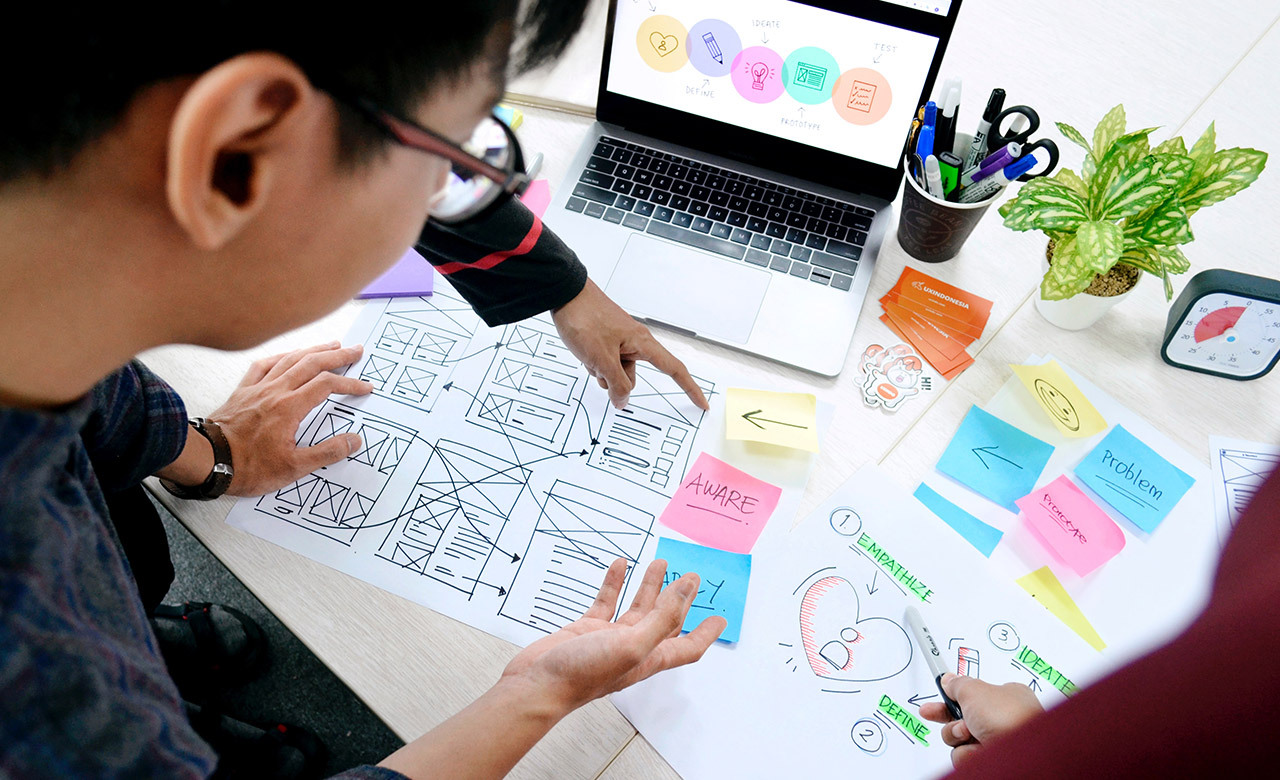
Design Thinking in e-learning
When you design an e-learning course, your goal is to provide learners with valuable and applicable information and skills. You want your e-learning to offer added value in both the short and long term.
The design of the e-learning is essential in this regard. Developing effective e-learning is a process of trial and error. Learn from mistakes, investigate the obstacles students encounter, and learn from their feedback.
Design Thinking is a process in which a challenge or problem faced by a learner or organization is identified, followed by a collaborative effort to find a solution to address this problem through e-learning.
How do you do this? We explain it below.
Empathize
To develop an e-learning course that truly resonates with your target audience, it is important to put yourself in their shoes. What does a typical workday look like? What challenges does the employee face? You can do this in several ways:
1. Conduct field research
Spend a day working on the shop floor, have coffee with colleagues to find out what is on their minds, and be open to honest and candid conversations.
Additionally, observe what their daily tasks mainly consist of.
Pay attention to areas where the employee gets stuck or seems to experience problems.
Also, keep an eye on their attitude and motivation!
2. Conduct interviews
Speak with people from different levels of the organization. Investigate whether what they want to learn aligns. Do they describe the same challenges, problems, and successes?
3. Create a persona
Based on the insights you have gathered through field research and interviews, create a persona. This persona embodies the collective traits and experiences the desires, needs, fears, and problems of your target audience.
Define the goal
E-learning often seems like a fairly simple, quick-to-implement solution to a problem. But nothing could be further from the truth.
Unfortunately, people often act too quickly, meaning insufficient time is invested in clearly defining the problem. This subsequently results in an e-learning course that fails to adequately address the issue, and therefore, the e-learning does not help solve the problem.
“Problem” sounds quite negative, but what we mean by this is that your target audience research has revealed a specific need.
Perhaps it is important for the organization that employees improve their soft skills, or maybe a new way of working has been introduced that requires thorough introduction and training. The latter example is quite concrete, but the first is harder to define.
- Which soft skills are missing?
- Are these soft skills missing among all employees or only within certain departments?
- Do employees also feel that these soft skills are important in their work?
- Are they currently experiencing problems or challenges in their daily work where these soft skills play a major role?
Next, connect concrete goals to the problem. Try to formulate these goals using the SMART (specific, measurable, achievable, relevant, and time-bound) framework.
Develop a concrete action plan
During this step, it is very important (though unfortunately not always done) to involve the target audience in the action plan.
Let the target audience contribute ideas about what they want to learn and how they want to learn it. This makes employees feel more involved in the e-learning from the very beginning and ensures they feel seen and heard, which boosts intrinsic motivation.
A few ways you can shape this:
1. Brainstorming: through discussions. Depending on the group size, you can divide them into smaller groups. Ultimately, the goal is for all groups to present what they consider the primary objective and how they want to achieve it. You can use posters or sticky notes for this.
2. Tap into the employees' creativity: for example, have employees draw what their ideal work scenario looks like and what they feel is still missing. Then, have them brainstorm how e-learning can contribute to the solution. Mind maps are also very suitable for this.
Want to learn more about e-learning? Download our free e-book full of E-learning Essentials!
Develop a prototype
Employees can best visualize the e-learning when they are given a visual presentation, for example in the form of a sketch, a simulation, or a trial learning environment.
You can get started with Pluvo for free. There are no costs associated with creating your prototype.
Ensure that the prototype clearly includes all the elements that the employees identified as important during the brainstorming sessions.
The employees then provide feedback, after which you can further adjust and refine the prototype for the target audience.
Test the first version
Wanneer de eerste versie van de e-learning af is, is de rol van de cursist nog niet afgelopen. Zij zijn namelijk essentieel voor het succes van de e-learning.
Vraag hen:
- Of je hen mag observeren terwijl zij de eerste module maken (zowel de persoon als de data)
- Of zij hardop willen denken zodat je hun gedachtenproces kunt volgen en evalueren
- Of zij hun vragen en feedback voor je op willen schrijven
Kortom, doe gedegen onderzoek onder jouw doelgroep voor je aan het ontwerpen van een e-learning begint. Zij zijn essentieel in het bepalen van het succes van jouw e-learning.
Betrek hen bij elke fase van het ontwerp en vraag actief hun feedback terwijl zij de training doorlopen.

Keep reading
Get inspired by our other blog posts