
Which model do you use to develop e-learning?
Two well-known models, ADDIE and Bloom's Taxonomy, explained as a guide for building a course.


Which model do you use to develop your e-learning?
If you have developed e-learning yourself, or are planning to do so, you will likely recognize this: you have a wealth of knowledge and skills that you are eager to share with your students. But you are not an expert in e-learning development! So, how do you go about it?
Fortunately, there are several models you can use to structure and simplify the creation of e-learning.
In this blog, we describe two models: ADDIE and Bloom's Taxonomy.
Why do we recommend working with a model of your choice? Because it makes things a lot easier for yourself. You gain a bird's-eye view and a clear overview. You know exactly what material to place at what point in your training and how it logically fits together. By using these models, you create a strong foundation that you can always build upon later.
ADDIE model
These are the five steps of the ADDIE model:
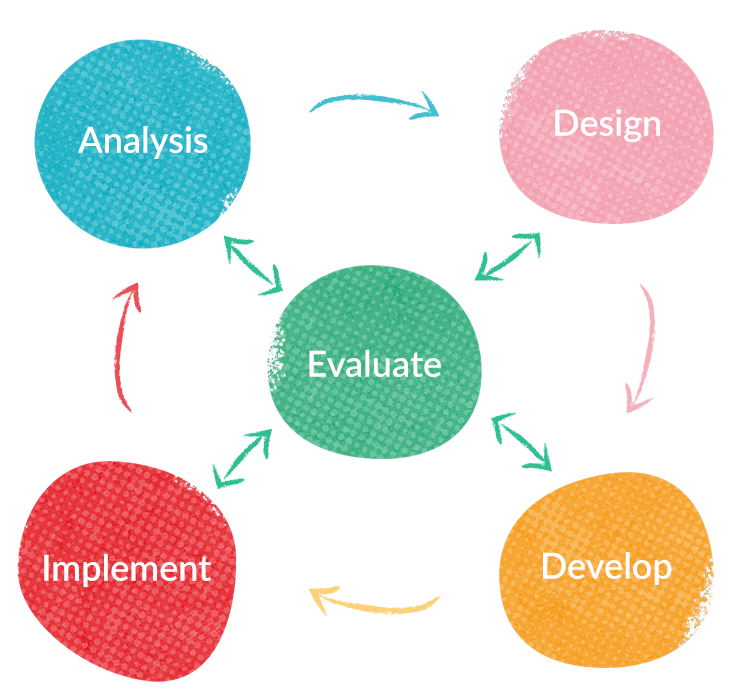
1. Analyze
Start by analyzing your target audience: who is your student? It is highly valuable to conduct target audience research before developing your e-learning so that you truly get to know them.
Next, ask yourself: what problem am I solving for my student? Once you have this clear, you can start filling in the training. How does your target audience prefer to learn?
Choose learning materials and activities in a format (video, audio, gifs, text) that suits your target audience.
The final step in this important phase is thinking about the execution of your e-learning: budget, platform, marketing, etc.
2. Design
In this phase, you actually start developing the training. You do this at two levels: at the "course level," where you look at the training as a whole and determine things like the title, goal, structure, and learning objectives.
And at the "unit level," where you determine the same things but go into more detail regarding the specific information per unit or module (information, activities, assessment).
3. Develop
Now it gets real! It is time to place your content into an online learning environment.
Pluvo is perfectly suited for hosting various forms of content such as video, text, audio, and gifs. We will, of course, help you with all the "technical" aspects involved in this step.
4. Implement
You can start welcoming your first students! In this step, it is essential to monitor how the learning experience is progressing. Is there interaction in the training?
How quickly or slowly are students moving through your training? Are you already receiving feedback? How do you stay engaged with your students?
5. Evaluate
Keep a close eye on your training. What do the statistics tell you? Also, ensure your training stays up to date. For example, have there been any interesting developments in your field?
If so, make sure to address them in your training. Do you keep receiving the same questions from students? Then create an FAQ section in your training. Do you notice that a certain topic is really resonating? Give it some attention. In other words: don't disappear; stay visible and active in your training!
Bloom's Taxonomy

Instructional designers often use Bloom's taxonomy to create learning outcomes that focus not only on the subject matter but also on the depth of learning, and subsequently to create assessments that accurately reflect student progress.
Bloom's taxonomy encompasses three domains of learning: the cognitive, affective, and psychomotor domains, and assigns a hierarchy to each of these domains that corresponds to different levels of learning. The various levels of thinking defined within each domain of the taxonomy are hierarchical. Students cannot move through these levels in random order because each step builds upon the previous one.
Broadly speaking, the hierarchy looks like this:
- Remembering: recalling information. Recognizing, describing, naming.
- Understanding: explaining ideas or concepts. Interpreting, summarizing, naming, classifying.
- Applying: using information in a different context. Executing, using, applying.
- Analyzing: breaking information down into parts to explore connections and relationships. Comparing, organizing, deconstructing, questioning.
- Evaluating: justifying a decision or event. Checking, hypothesizing, critiquing, experimenting, judging.
- Creating: generating new ideas, products, or points of view. Designing, creating, planning, producing, inventing, building.
Once you have determined and designed the sequence and content of your e-learning using (one of) the models above, you can place the content into an online learning environment (like Pluvo ;)). Create a free account here!

Keep reading
Get inspired by our other blog posts